You’re Invited to Rest: Three Ways to Accept the Invitation to Rest
Receiving an invitation can produce a host of responses. Sometimes the responses will be filled with excitement and joy whereas, other times, not so much. Like invitations we receive through our modern-day mail or social media, our responses may vary to the invitations Jesus offers. One invitation, in particular, has always stirred mixed emotions in me, and maybe for you too: Jesus' invitation to rest.
The Invitation
Most invitations we receive are to some type of celebration: birthday, wedding, baptism, etc. We may also receive invitations to participate in an activity: book club, paint party, and more. With these invitations there is activity. We are engaging others and participating in some type of event. However, there is another type of invitation that we rarely receive from this world: the invitaiton to rest.
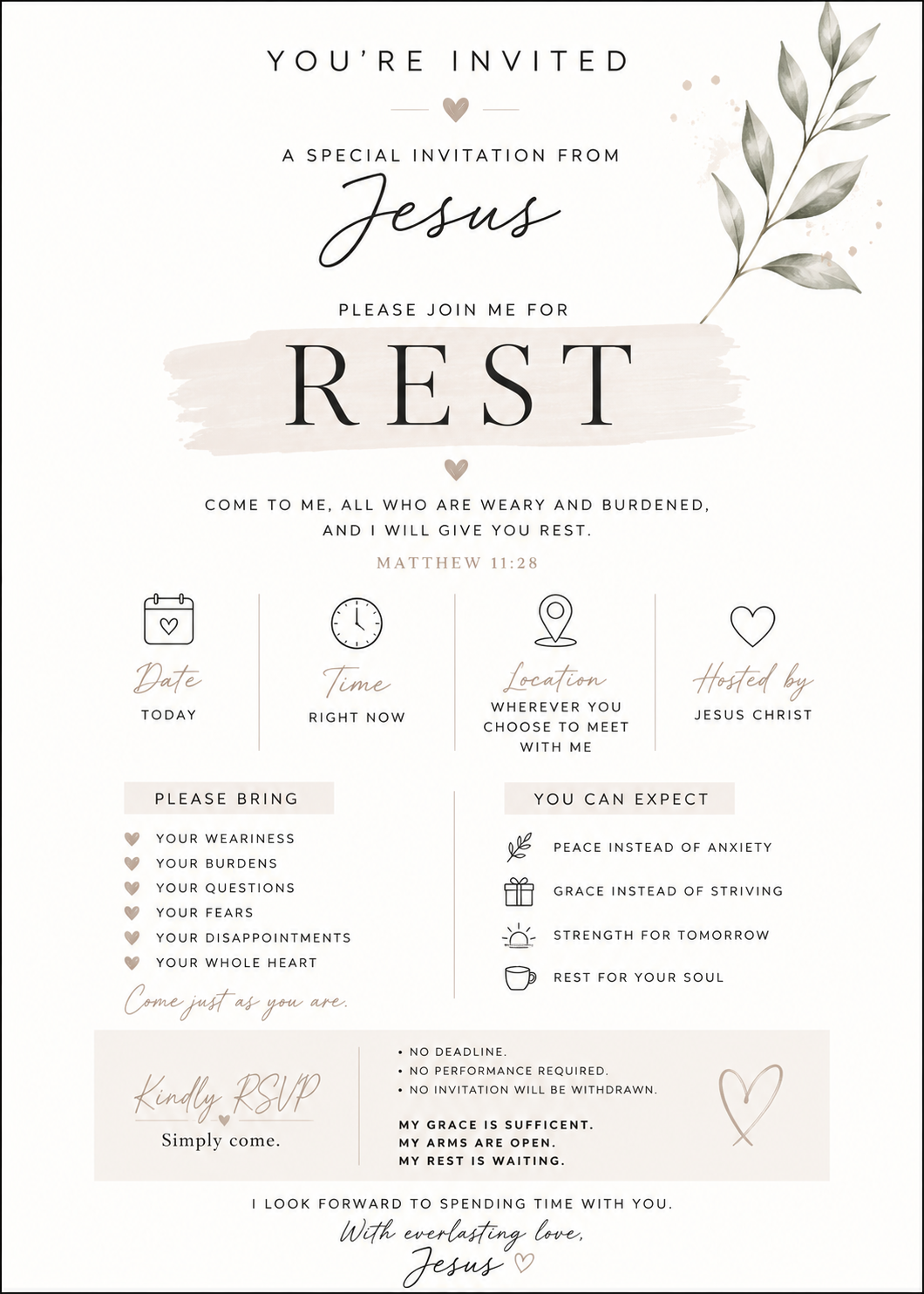
While the world very rarely calls us to rest, Jesus offers a standing invitation to “Come to me all who are weary and heavy burdened, and I will give you rest” (Matthew 11:28, NIV). Jesus understood what it was like literally to carry the weight of the world on his shoulders. And even he took time to rest. Jesus retreated to solitary places to pray and rest (Mark 1:35), when he needed rest from a journey (John 4:5-6), and when he was tired (Matthew 8:23-24). Resting is not laziness or weakness; it is biblical.
Jesus’ invitation to rest not only is for our bodies, minds, and hearts, but also for other areas: our marriages, our work, our friendships, our hopes and desires. With them all, we can find rest in a Savior that can teach us how to sleep in the storm.
Three Ways to Find Rest:
1) Acknowledge you need it
Most of us would rather run ourselves in the ground than to admit we need rest. Yet without acknowledging the rest we need, we will find ourselves using our limited strength that will eventually run dry. When we reactively rest, we are often burned out physically, mentally, emotionally, and spiritually. This may result in making us prone to sickness, vulnerable to temptation and weaken our discernment.
However, acknowledging our need for rest is proactive rather than reactive rest. This is not weakness. When we admit our need for rest, we exercise humility. We recognize our limitation in our humanity and recognize God’s infinite strength to hold us while we rest. It is here we can accept Jesus’ offer, “Accept my teaching. Learn from me. I am gentle and humble in spirit. And you will be able to get some rest” (Matt. 11:29, ERV). It is in this space we can experience rest in our marriage, friendships, desires, and more.
2) Commit to the rest
Many of us readily admit that we need rest, yet we often deny ourselves the very invitation Jesus desires to give us. We long for the peace, clarity, and renewal that rest provides, but we cannot experience its benefits without first embracing its practice. Rest is not something we simply wish for; it is something we choose.
God reminds us in Psalm 46:10, “Be still, and know that I am God” (NIV). Notice the first invitation: be still. Before we are called to do anything, we are first invited to stop striving and recognize who God is and our need for him. Jesus echoed this same invitation throughout His ministry. He regularly withdrew to quiet places to pray and rest, modeling dependence on the Father to sustain his needs. Then, in Jesus’ grace, He extends that same invitation to us: to lay down our burdens, be still in His presence, and find true rest for our souls.
3) Routinely rest
Dallas Willard, a respected Christian philosopher who wrote extensively on spiritual disciplines, wisely observed, "If we do not come apart for a while, we will fall apart after a while." His words remind us that rest is not a luxury; it is a necessity. Willard also taught that rest is an act of faith, positioning us to receive God's grace, wisdom, and discernment. When we choose to rest, we acknowledge that God is our source of strength rather than ourselves.
This rhythm of rest echoes throughout the Gospels also. We continually see Jesus intentionally withdrawing to solitary places before and after ministering to the crowds. These moments were not interruptions to His ministry; they were essential to it. In these spaces of quiet and solitude, Jesus communed with the Father, found renewal, and prepared for what lay ahead. He never carried guilt or shame for stepping away. Instead, He demonstrated that abiding with the Father was the source of His strength. Jesus knew His power streamed from continual connection with the Father, and by modeling this rhythm of retreat and return, He invites us to do the same.
Final Thoughts
Resting is not easy. It goes against the grain of what our society often teaches and maybe even we were raised to believe about rest. However, Scripture is clear that rest is necessary. It was necessary for the son of God, and it is necessary for us. Jesus has sent us an invitation. Will you acknowledge it and commit to it? Will you make it a way of life?